LFG: Learning to Drive is a Free Gift
Large-Scale Label-Free Autonomy Pretraining from Unposed In-The-Wild Videos
CVPR 2026



Abstract
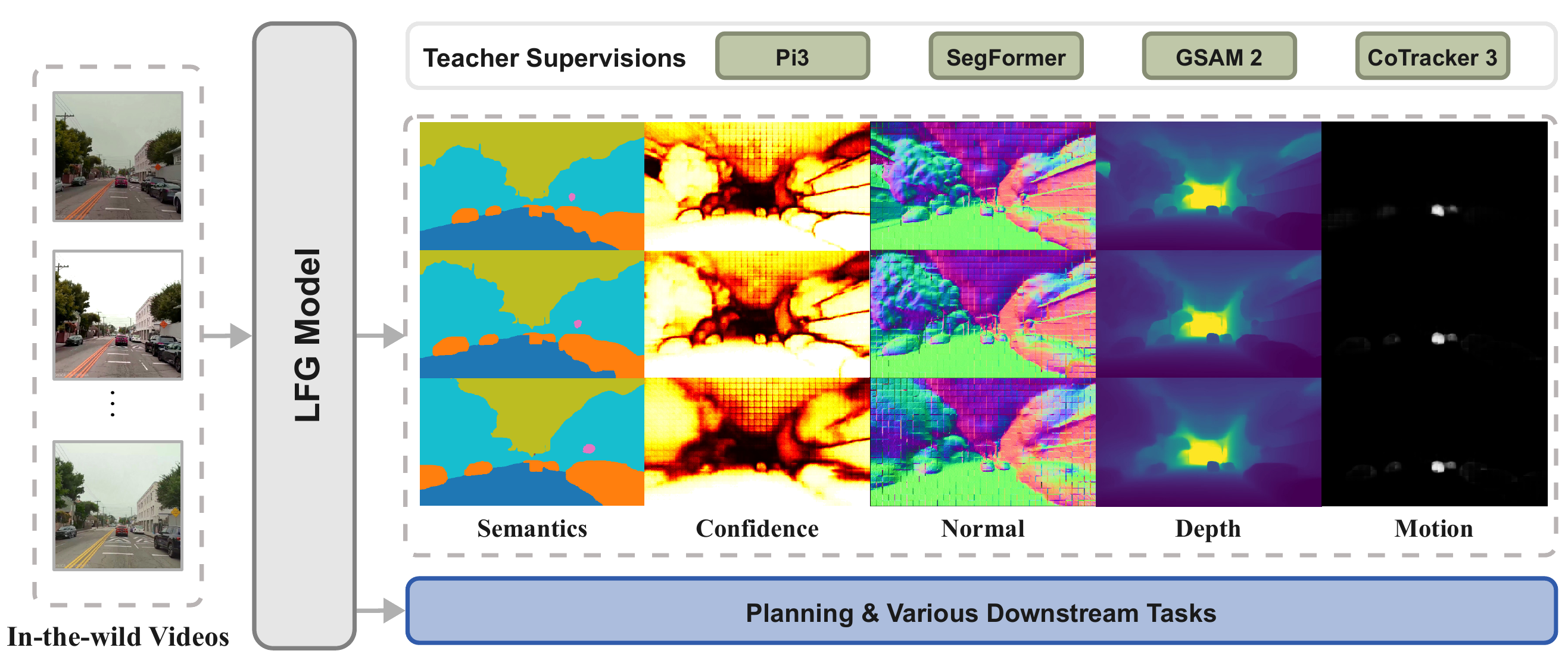
Ego-centric driving videos available online provide an abundant source of visual data for autonomous driving, yet their lack of annotations makes it difficult to learn representations that capture both semantic structure and 3D geometry. Recent advances in large feedforward spatial models demonstrate that point maps and ego-motion can be inferred in a single forward pass, suggesting a promising direction for scalable driving perception. We therefore propose a label-free, teacher-guided framework for learning autonomous driving representations directly from unposed videos.
Unlike prior self-supervised approaches that focus primarily on frame-to-frame consistency, we posit that safe and reactive driving depends critically on temporal context. To this end, we leverage a feedforward architecture equipped with a lightweight autoregressive module, trained using multi-modal supervisory signals that guide the model to jointly predict current and future point maps, camera poses, semantic segmentation, and motion masks.
Multi-modal teachers provide sequence-level pseudo-supervision, enabling LFG to learn a unified pseudo-4D representation from raw YouTube videos without poses, labels, or LiDAR. The resulting encoder not only transfers effectively to downstream autonomous driving planning on the NAVSIM benchmark, surpassing multi-camera and LiDAR baselines with only a single monocular camera, but also yields strong performance when evaluated on a range of semantic, geometric, and qualitative motion prediction tasks.
We emphasize that the novelty of LFG lies more within the pretraining paradigm than the model architecture itself.
Method at a Glance
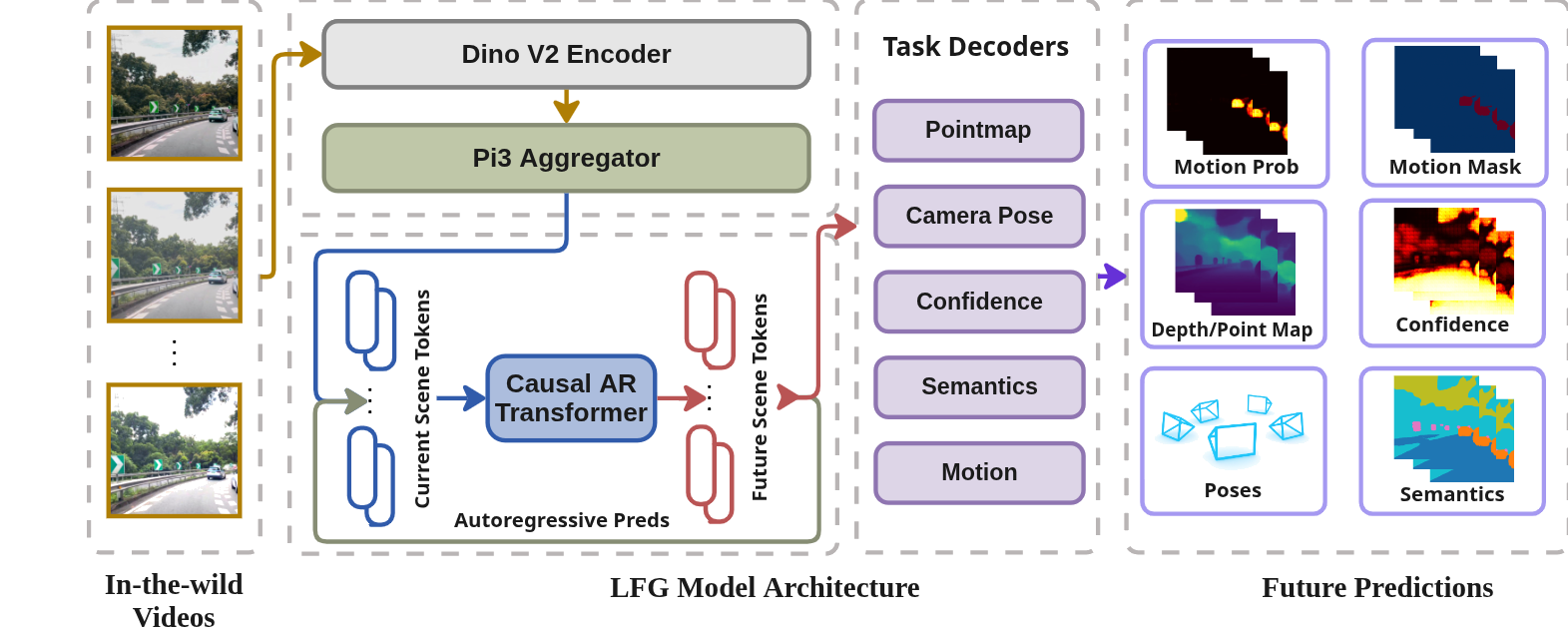
LFG Architecture. Starting from unposed single-view driving clips, a pretrained π3 backbone encodes N observed frames into latent scene tokens. A lightweight causal autoregressive transformer rolls out M future tokens, which a shared decoder maps to point maps, camera poses, semantic segmentation, confidence maps, and motion masks for all N+M frames. Multi-modal teachers provide pseudo-supervision, enabling LFG to learn a unified pseudo-4D representation that transfers effectively to downstream planning.
Motion Prediction
LFG separates what moves (vehicles, pedestrians) from the static scene while the camera itself is moving, with no human motion labels.
Left: input frame. Right: LFG's predicted motion mask (red = moving).
LFG's soft motion masks follow the teacher's pseudo labels closely; blue = static, red = moving.
Depth Estimation
LFG sees only frames 1–3 and predicts depth for frames 4–6 it has never seen. The π3 teacher is given all 6 frames.
On future frames, LFG's depth stays close to the teacher's, which was given the frames LFG has to imagine.
Semantic Segmentation
LFG is distilled from a SegFormer teacher, yet beats it, including on future frames where SegFormer gets the real image and LFG does not.
Point Cloud Reconstruction
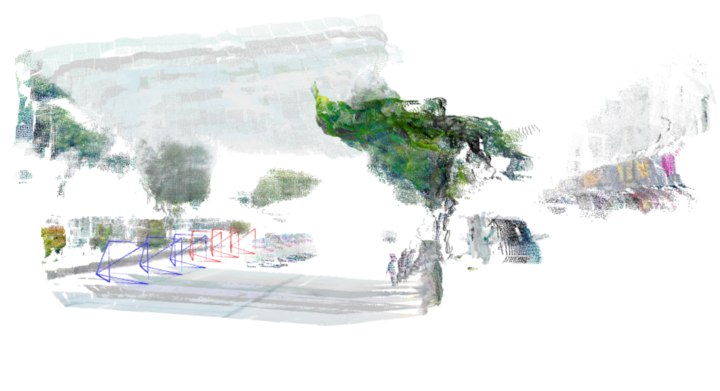
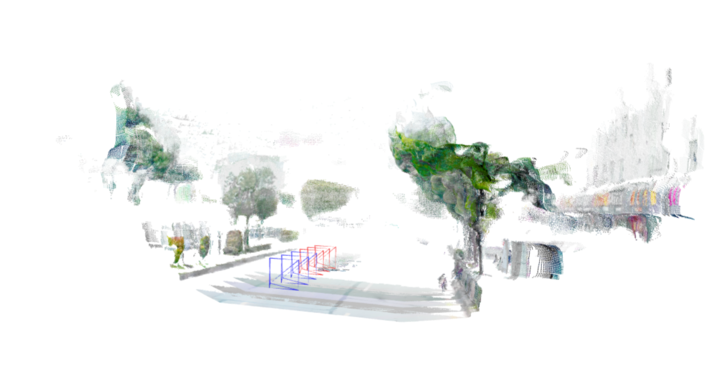
Stacking the predicted point maps gives a full reconstruction. LFG keeps the scene's structure and the camera path even for the frames it predicts.
In the Wild
Three frames in, three frames predicted, on driving videos LFG never trained on.
Each clip steps through the 6 frames: the RGB frame, LFG's predicted depth and segmentation, and a bird's-eye view of the 3 observed (blue) and 3 predicted (orange) camera poses.
Quantitative Results
NAVSIM Planning Benchmark
Single-camera LFG vs BEV-based baselines. Higher is better for all metrics.
| Method | Input | NC | DAC | TTC | C. | EP | PDMS |
|---|---|---|---|---|---|---|---|
| BEV baselines | |||||||
| UniAD | 6Cam | 97.8 | 91.9 | 92.9 | 100.0 | 78.8 | 83.4 |
| TransFuser | 3Cam+L | 97.7 | 92.8 | 92.0 | 100.0 | 79.2 | 84.0 |
| Hydra-MDP | 3Cam+L | 96.9 | 94.0 | 94.0 | 100.0 | 78.7 | 84.7 |
| DiffusionDrive | 3Cam+L | 96.8 | 95.4 | 94.7 | 100.0 | 82.0 | 88.1 |
| LFG (ours) | 1Cam | 98.2 | 93.7 | 94.4 | 100.0 | 79.1 | 85.2 |
Bold = best in column. L = LiDAR. 1Cam uses only the front-view camera with past temporal frames (3-frame input).
Label Efficiency
NAVSIM PDMS when fine-tuning with 1%, 10% and 100% of the labeled data. The pretrained encoders use a single front camera (3 frames) and the same anchor-based decoder.
| Method | Input | 1% | 10% | 100% |
|---|---|---|---|---|
| DiffusionDrive | 3Cam+L | 64.9 | 72.6 | 88.1 |
| DiffusionDrive-DINOv2 | 3Cam+L | 57.3 | 74.4 | 81.5 |
| DiffusionDrive-DINOv2 | 1Cam | 57.5 | 73.0 | 79.7 |
| Pretrained encoders, 1 camera | ||||
| DINOv3 | 1Cam | 60.0 | 75.8 | 81.4 |
| PPGeo | 1Cam | 61.5 | 65.6 | 74.6 |
| π3 | 1Cam | 56.2 | 77.5 | 82.8 |
| LFG (ours) | 1Cam | 66.3 | 81.4 | 85.2 |
LFG is best at 1% and 10% labels and the best single-camera encoder at 100%. DiffusionDrive is trained end-to-end with a BEV ResNet backbone.
Semantic Segmentation
KITTI-360, 200 sequences of 6 frames. SegFormer gets all 6 images; LFG gets the first 3 and predicts the rest. Future = frames 4–6 only.
| Method | All frames | Future frames | ||||||
|---|---|---|---|---|---|---|---|---|
| PA | mIoU | mDice | FW | PA | mIoU | mDice | FW | |
| Static baseline | – | – | – | – | 0.888 | 0.420 | 0.502 | 0.810 |
| SegFormer | 0.926 | 0.677 | 0.744 | 0.723 | 0.926 | 0.680 | 0.747 | 0.725 |
| MaskFormer | 0.922 | 0.760 | 0.829 | 0.760 | – | – | – | – |
| LFG (ours) | 0.947 | 0.768 | 0.827 | 0.770 | 0.942 | 0.751 | 0.814 | 0.759 |
The static baseline copies the ground truth of frame 3 to the future frames. PA = pixel accuracy, FW = frequency-weighted IoU.
Depth
Error after scale-and-shift alignment (lower is better). π3 sees all 6 frames.
| Method | All frames | Future | ||
|---|---|---|---|---|
| AbsRel | RMSE | AbsRel | RMSE | |
| KITTI-360 | ||||
| π3 | 0.26 | 4.37 | 0.26 | 4.37 |
| LFG | 0.27 | 4.38 | 0.31 | 4.38 |
| VGGT | – | 4.46 | – | 4.46 |
| DA3 | – | 4.43 | – | 4.44 |
| Waymo | ||||
| π3 | 0.19 | 6.68 | 0.19 | 6.70 |
| LFG | 0.21 | 6.87 | 0.22 | 7.12 |
Camera Trajectory
ATE and relative pose error, rotation (deg) and translation (m). Lower is better.
| Method | ATE | Rot | Trans |
|---|---|---|---|
| KITTI-360 | |||
| π3 | 0.43 | 1.32 | 0.31 |
| LFG | 1.00 | 2.30 | 0.31 |
| Waymo | |||
| π3 | 0.02 | 0.98 | 0.44 |
| LFG | 0.08 | 1.00 | 0.44 |
LFG's geometry stays close to its π3 teacher even though it never sees the last 3 frames. Depth RMSE in meters; standard deviations are in the paper.
Ablation Studies
Component and scaling ablations on NAVSIM (PDMS). Higher is better.
| Setting | 1% | 10% | 100% |
|---|---|---|---|
| LFG (original setting) | 66.3 | 81.4 | 85.2 |
| + 2× pretraining data | 76.6 | 82.3 | 84.8 |
| + Longer prediction horizon | 80.5 | 84.4 | 84.8 |
| − Seg, Motion | 64.8 | 77.1 | 84.6 |
| − Autoregressive head | 66.3 | 77.7 | 84.2 |
More pretraining data and a longer prediction horizon help most when labels are scarce; removing segmentation/motion supervision or the autoregressive head hurts.
BibTeX
@inproceedings{strong2026lfg,
  title={Learning to Drive is a Free Gift: Large-Scale Label-Free Autonomy Pretraining from Unposed In-The-Wild Videos},
  author={Strong, Matthew and Chang, Wei-Jer and Herau, Quentin and Yang, Jiezhi and Hu, Yihan and Peng, Chensheng and Zhan, Wei},
  booktitle={Proceedings of the IEEE/CVF Conference on Computer Vision and Pattern Recognition (CVPR)},
  year={2026}
}